
A Trauma-Informed Approach to Flashbacks?

Chaïm Soutine, The Table, ca. 1919. – Source (Sailko, CC BY-SA 3.0) Public Domain.

A Trauma-Informed Approach to Flashbacks?
Author: LEWIS, Richard
Abstract
The study investigates the possibility of mitigating a presentation of the phenomenon known in psychiatry as Hallucinogen Persisting Perception Disorder (HPPD) with a relational psychotherapeutic intervention.
HPPD is described in the Diagnostic and Statistical Manual of Mental Disorders (5th ed.; DSM–5; American Psychiatric Association, 2013) as the distressing and disabling onset of perceptual aberrations associated with psychedelic intoxication, long after discontinuation of the drug. While its population prevalence is unknown, HPPD may affect as many as one in 25 psychedelic users [1]. Despite this, HPPD is poorly understood and has limited treatment options [2].
The growing interest in the potential therapeutic use of psychedelics, coupled with the recent down-scheduling of psilocybin and ketamine for clinical use in Australia, suggests this group of drugs has been deemed safe for distressed populations. However, the growing body of work on HPPD suggests the phenomenon may be a predictable side-effect. It therefore becomes useful to investigate how HPPD can be handled. While pharmacological treatments have been proposed, these have associated risks of adverse reactions and/or discontinuation issues. Psychosocial interventions would reduce such risks [3].
The present study sought to establish whether relational psychotherapy alone could be effective in lessening the distressing aspects of a presentation of HPPD. A group of 10 self-selecting volunteers who met the diagnostic criteria for HPPD were offered Humanistic psychotherapy. Two agreed to move forward with the purely relational approach but one withdrew research consent. The remaining subject, who had taken psilocybin, was then offered open-ended psychotherapy via 50-minute online sessions.
The therapy was successful not only in mitigating the distress but also — unexpectedly — in reversing the perception of visual disturbance. This result firstly lends weight to existing studies [4] that suggest anxiety and post-traumatic dissociation may be factors in determining a person’s HPPD phenomenology and, secondly, builds on existing casework that suggests psychosocial responses alone may potentially offer for such cases a complete and sufficient response.
While caution is needed in interpreting results from such a small sample, these initial findings make a promising case for conducting further, more comprehensive research. Additionally, the current study offers additional support to recent evidence that psilocybin can be implicated in HPPD, where it was historically thought to be exempt [5].
Introduction
In June 2023, Australia became the first country to regulate psilocybin for medical use. Following its down-scheduling by the Australian drugs regulator, the Therapeutic Goods Administration (TGA), psychiatrists will be able to prescribe psilocybin (and also MDMA) for the treatment of post-traumatic stress disorder (PTSD) and depression. Such a change in legislation implies the drug has been found safe and effective for this use case, but Kisley (2023) argues the decision was “ahead of the available evidence” and went against expert advice.
Why the caution? Some researchers have spent careers playing down the risk from psychedelics. Drug policy campaigner David Nutt, for example, who presented to Australia’s drug regulator shortly before its down-scheduling decision [6], describes psychedelics generally as “among the safest drugs we know of” (Nutt, 2012) and more specifically ranks psilocybin as the least harmful in a range of 20 drugs including alcohol, heroin and crack cocaine (Nutt, 2010). Nutt’s conclusions are open to criticism. For example, the paper uses a methodology based on absolute population use, by which measure buprenorphine, a highly addictive opioid painkiller, was considered the second least-harmful. Despite its problems, this paper received widespread media attention and is often cited in harm-reduction sources, such as the Drug Policy Alliance [7].
Johannsen and Krebs (2015), who also argue against prohibition, flatly state that psychedelics are “not linked to” mental health problems or suicidal behaviour, by arguing that any correlation of psychedelic use and psychiatric illness is a statistical coincidence. Muller et al (2022) found drug-like experiences did reoccur after clinical administration of psilocybin but dismissed the incidence and experience as “not clinically relevant”.
When increased suicidality was indeed observed in subjects who had taken part in psilocybin trials (Goodwin et al, 2022), Nutt, commenting to the Guardian [8] argued that it was probably unrelated to the drug, as it would have already left the body. This latter argument, that the drug cannot be implicated if it has left the body, also seen in Johannsen and Krebs (2015), fails to allow for the phenomenon of hallucinogen persisting perception disorder (HPPD), which by definition occurs only after the drug has left the body and has indeed been linked to depression, anxiety and suicidality (Prideaux, 2023).
HPPD definitions
DSM-5 recognises HPPD as the “re-experiencing”, after discontinuation of the drug, of any of the perceptual symptoms experienced while intoxicated with the hallucinogen. The manual gives a non-exhaustive list of examples:
- geometric hallucinations
- false perceptions of movement in the peripheral visual fields
- flashes of colour
- intensified colours
- trails of images of moving objects
- positive afterimages
- halos around objects
- macropsia and micropsia
The presentation may occur weeks, months, years or decades after use (APA, 2013). To meet the diagnostic criteria, other diagnoses such as head injury or psychosis disorders must be ruled out and, crucially, the visual effects must be accompanied by distress or functional impairment.
The criterion of “re-experiencing” has come under criticism: researchers such as Halpern et al (2016), for example, have noted some post-psychedelic perceptual differences were never experienced during the original psychedelic event. Moreover, HPPD displays similarities to other phenomena such as Visual Snow Syndrome; it is therefore possible that “HPPD” is currently a broad descriptor for a range of visual perceptual changes in which psychedelic drugs can be the precipitant, although other drugs can alos play that role. Drugs not classically defined as psychedelic that are also associated with HPPD include MDMA, ketamine, DXM, DPH, cannabis and SSRI anitidepressants.
Both DSM-5 and Baggot et al (2011) put the prevalence of HPPD at around 4%, or one in 25 lifetime psychedelic users. DSM-5 finds LSD to be the most typically cited hallucinogen associated with the diagnosis but notes that HPPD is not exclusive to LSD. Prideaux (2023) found evidence to suggest psilocybin in fact played a “considerable role” for many.
The case for chemical treatment
The precise etiology of HPPD is not currently known, and despite the prevalence of HPPD-like presentations, there is a paucity of research into appropriate therapeutic responses. Since Abraham (1983) put forward the hypothesis that hallucinogens might dampen the production of Gamma-Aminobutyric Acid (GABA), effectively hampering the normal filtering of visual noise, pharmacotherapy approaches have sought to treat HPPD presentations with GABA receptor agonists such as benzodiazepines: diazepam, alprazolam and clonazepam have all been implicated in HPPD treatment (Martinotti et al, 2018). On the other hand, Schöpf (1983) notes that benzodiazepine withdrawal can also create visual disturbances similar to those described by HPPD, suggesting that while benzos may appear to calm HPPD in the sort term, there is a possibility that long-term use might make it worse. Interestingly, if counter-intuitively, Prideaux (2021) notes that some people report reversing the effects of HPPD through additional psychedelic use.
The understanding of HPPD as a disruption in normal brain chemistry, however, lacks evidence and DSM-5 notes that neuroimaging results in HPPD are “typically negative”. DSM-5 also notes that HPPD typically remains chronic. Long-term benzodiazepine use, on the other hand, has well documented side-effects [9] and discontinuation issues that may add symptoms, compound distress and, according to Greenblatt (1990), merely “contain disorders” without reversing them. It is possible that benzodiazepines may simply be calming symptomatic anxiety, in which case non-biological approaches may offer similar results without the potential for harm.
The case for psychosocial approaches
There are two reasons to consider psychosocial approaches to HPPD presentations. Firstly, by eliminating the risk of side effects, discontinuation issues and adverse reactions associated with benzodiazepines (or repeat doses of psychedelics), purely psychosocial approaches would clearly offer a safer alternative, if they could be shown to be as effective. HPPD non-profit the Perception Restoration Foundation (PRF), has documented (2022) evidence to suggest psychosocial approaches have indeed been effective. However, until now research has focused either on types of cognitive or behavioural psychotherapy, which tend to focus on changing habitual thoughts and behaviours to shift focus away from the visual disturbances, or on relaxation and exposure.
Humanistic therapies differ from these in their typical reluctance to force change in the subject’s thinking, attitudes and behaviours, or “treat” the symptoms with a quasi-medical intervention and, rather, in their insistence that the building of relational safety between two individuals is therapeutic and sufficient in itself, allowing difficult experiences to be integrated, rather than tuned out. However, Humanistic therapy lends itself less well to empirical research, as it is challenging to measure concepts such as “relational safety”. We must instead rely on casework, where a subject’s increasing willingness over time to share and explore more difficult experiences, sensations and feelings suggests psychological and emotional safety is growing. Such research will always be open to criticism, which is why it is important to publish a volume of casework.
Secondly, given that distress is a deciding factor in diagnosis, and given that HPPD typically does not correlate with abnormal brain scans, the wider question is whether HPPD is best understood as a brain abnormality at all or whether it might be better understood as falling within the range of typical threat or trauma responses. There is some support for this conjecture: Halpern et al (2016) note that HPPD-like experiences, such as flashbacks, moments of de-realisation, and hyper-intense perceptions are also reported in healthy populations, while Irvine and Luke (2022) consider anxiety a mediating factor in individual differences in HPPD phenomenology.
Research goal and methodology
The scope of the current study was not to seek evidence for either etiology but, rather, to assess whether a precedent could be set for mitigating a subject’s typical presentation of HPPD distress through purely relational responses; this is to say that the focus of therapy would be building a relationship of trust and empathy in which the client felt safe and able to share and explore the most distressing aspects of their experience without fear of judgement or repercussion.
A cohort of 10 clients who self-referred for therapy via the PRF were checked against the DSM-5 diagnostic criteria for HPPD. They were then offered an open-ended and mutually negotiated series of 50-minute sessions of Humanistic psychotherapy, containing elements of Person Centred and Gestalt Therapy. The approach was explained as a strictly non-medical intervention that would explore and aim to reduce their distress, while their visualisation experiences may not be altered. Most declined psychotherapy, preferring to continue their search for a sympathetoc medical doctor.
Those who accepted this approach were then offered the further chance to take part in research, by consenting to publication of their anonymised case studies. This triage process resulted in a single suitable case study for this initial round of research.
Barriers to psychosocial approaches
The medical model of distress is pervasive in public imagination. Data captured as part of the triage of potential volunteers, while statistically marginal given the small sample of 10, does highlight one of the difficulties in testing non-medical interpretations and approaches. Fully 80% of those polled declined a purely psychotherapeutic approach, insisting that they had a brain injury and preferring to keep looking for a sympathetic medical doctor, even though their GP and specialists had been unable to help. Of the 20% who agreed to psychotherapy, half withheld case study consent due to fears over repercussions.
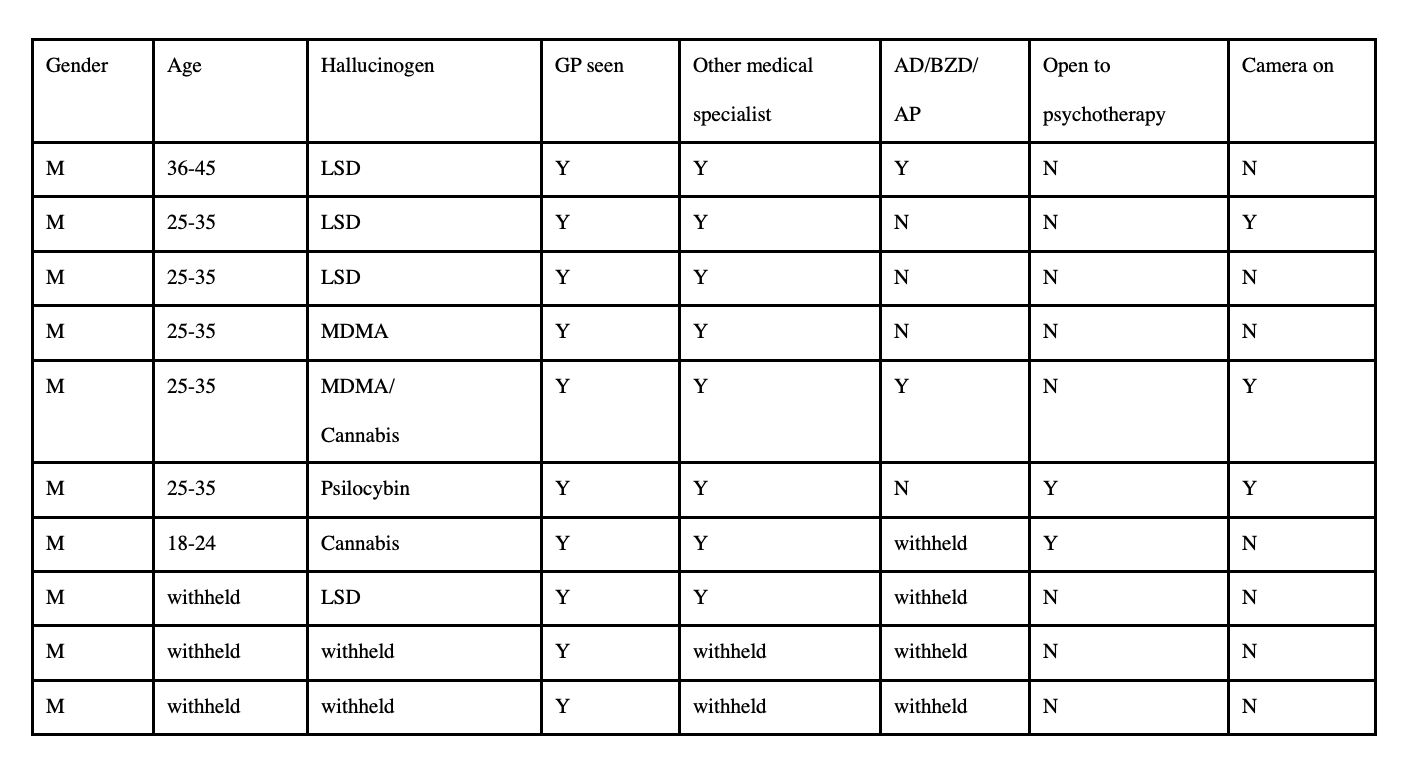
The table above shows a degree of reticence among members of this population to share information (40%), or to be seen on camera during an initial consultation over web video (70%).
Summary and results
A young male subject, M, complained of intrusive, distressing visual disturbances including floaters, haloes and the impression of viewing life through a gauze, with associated impairment to quality of life, beginning roughly one month after taking a single dose of psilocybin. The psychedelic experience had overwhelmed and frightened M in both its sensory and emotional intensity. Following cessation of the drug, M had been left with an abiding sense of desolation and loneliness, in feeling permanently detached from his family by the singular nature and intensity of his life experience – and this could not be reconciled with his yearning for family and companionship. He struggled to make meaning from this.
The focus of the therapy was M’s distress and not M’s perceptual disturbances. Over 17 50-minute sessions of Humanistic psychotherapy, in which he surfaced and worked through a number of troubling aspects of his life, M was able to: recognise as equally valid, and hold simultaneously, two or more competing aspects of himself that previously had been holding him in taut stasis; reach an understanding of his own nature and how it differed from the introjected self; recognise and advocate for his own needs without betraying his own desire for harmony in relationships, and create a model for family that respected all of his parts. In the process of integrating both the difficult “messages” of the psychedelic experience and the competing aspects of self it had highlighted, the previously troubling and intrusive visual aberrations dimmed in importance and were finally discarded and forgotten as M took steps into a self-determined future.
While any conclusions must be tentative, the dimming of the perceptual disturbances in step with the integration of the distressing emotional material suggests that it may be premature to understand HPPD as a brain abnormality caused by the drugs and that the emotional distress typically observed with HPPD may actually be a causal factor in the onset of visual disturbance and not merely an effect of it.
A possible inference from this line of reasoning is that the visual experiences might be understood as part of a dissociative depersonalisation or derealisation experience prompted by traumatic experiences, including but not limited to the psychedelic experience itself. There is some support for this idea in Halpern et al (2016) and Holland and Passie (2011), find that dissociative experience, poor interoception and visual disturbance are related by high trait absorption and trait dissociation, raising questions about trait-based analyses of HPPD.
In this case the psychedelic experience was traumatic, not just in the moment, but in its apparent emotional legacy. If this understanding of HPPD attracted further evidence, then it may encourage more people to try purely psychosocial interventions as a first-line response to presentations of HPPD. Moreover, it may also also call into question whether psychedelics really do offer a safe and appropriate treatment for people already experiencing clinically significant levels of emotional distress.
A psychosocial approach to HPPD is not without barriers. Firstly, given how difficult some of the emotional material was to voice for M, HPPD sufferers may feel more comfortable containerising unbearable distress within the convenient construct of a biological injury with a technological solution. This approach avoids having to expose, feel and integrate difficult emotional material. Secondly, the efficacy of relational therapy relies upon the building of relational safety in the dyad, which may take more time than the sufferer is able to commit. This case took 17 sessions, which may be relatively short for this type of therapy and yet in many cases too long to attract public funding for clinical pathways.
Session-by-session observations
M presented following a distressing psilocybin experience that had left him feeling permanently alienated from his family and disconnected from reality, compounded by longstanding difficulties with social belonging, body image, and an unplanned fatherhood situation abroad that left him financially exploited and largely denied access to his daughter. Over the course of therapy, it became clear that the psilocybin experience had not created these feelings so much as surfaced patterns of isolation, scapegoating and unmet attachment needs that traced back to childhood. Work progressed through exploration of conflicting internal parts — duty versus need, sacrifice versus self-preservation — and M gradually developed the capacity to hold these in tension rather than feel split apart by them. A brief introduction to Transactional Analysis proved particularly significant, enabling M to disentangle his emotional responses from K’s manipulative communications and engage with her from a more grounded, adult position.
By the later sessions, M had moved from a static sense of entrapment to active agency: negotiating direct caregiving time with his daughter, pursuing employment opportunities abroad, and forming a meaningful romantic relationship. Somatic complaints including visual disturbances and uncontrolled eating, which appeared closely linked to states of dissociation and unresolved internal conflict, resolved progressively as his sense of integration deepened. Therapy concluded naturally at 17 sessions when M reported feeling present in his body, known by those close to him, and no longer in need of an inward-facing reflective space.
Conclusions
Pharmacological treatments for mental health presentations such as depression come with side-effects that psychosocial approaches do not. As the interest in the therapeutic use of psychedelics grows, it is important that those who choose this treatment path do so with fully informed consent. In the case of psychedelics, the ethical clinician cannot ignore the statistical probability that a proportion of those who choose this therapy type will go on to report the experiences described as HPPD. Patients choosing psychedelic therapy should feel satisfied that they are aware not just of the likely efficacy of the treatment, but also of the likelihood of experiencing distressing side effects and of the full range of options for handling these should they occur.
This case study provides further support for existing evidence [10] that HPPD might be understood not as a brain abnormality or injury cased by the psychedelic, but as part of a post-traumatic de-realisation or de-personalisation experience. Thus, in contrast to historic interpretations of HPPD as a GABA imbalance that can be treated by the use of benzodiazepines (Abraham, 1983), the success of relational psychotherapy in reversing the perception of intrusive visual disturbances and associated distress builds on existing casework indicating cognitive psychological approaches and suggests the utility of further research into the suitability of a range of trauma-informed psychosocial treatments as a first-line response to HPPD presentations.
Limitations
Small sample size and self-report of both disturbance and beneficial results. The diagnostic criteria are also problematic: given there is no objective measure for HPPD, there is disagreement over what “counts” as HPPD – sometimes even within the same paper. Commentators such as Halpern et al (2016), for example, have suggested prior history of visual effects such as floaters may both predispose a subject to HPPD and rule the diagnosis out.
Declaration of conflicting interests
The author(s) declared no potential conflicts of interest with respect to the research, authorship and/or publication of this article.
Funding
The author(s) received no financial support for the research, authorship and/or publication of this article.
Footnotes
[1] Baggot et al, 2011
[2] Martinotti et al, 2018
[3] Perception Restoration Foundation, 2022
[4] Irvine & Luke, 2022; Stott, 2009; Bruch, 2015; Genova, 2013
[5] Prideaux, 2023
[6] Blau & Thompson/ABC News, 2023
[7] Drug Policy Alliance, 2023
[8] Sample/The Guardian, 2022
[9] Edinoff et al, 2021
[10] Irvine & Luke, 2022; Stott, 2009; Bruch, 2015; Genova, 2013
References
Abraham HD. Visual phenomenology of the LSD flashback. Arch Gen Psychiatry. 1983 Aug;40(8):884-9. doi: 10.1001/archpsyc.1983.01790070074009. PMID: 6135405.
American Psychiatric Association. (2013). Diagnostic and statistical manual of mental disorders (5th ed.). https://doi.org/10.1176/appi.books.9780890425596
Baggott MJ, Coyle JR, Erowid E, Erowid F, Robertson LC. Abnormal visual experiences in individuals with histories of hallucinogen use: a Web-based questionnaire. Drug Alcohol Depend. 2011 Mar 1;114(1):61-7. doi: 10.1016/j.drugalcdep.2010.09.006. Epub 2010 Oct 28. PMID: 21035275.
Blau, A. and Thompson, G. (2023) Psychedelics may have cured andrew, but TGA’s decision making on drugs raises ‘serious concerns’ for some, ABC News. Available at: https://www.abc.net.au/news/2023-03-18/psychedelic-charity-accused-lobbying-tga-mdma-psilocybin/102103782 (Accessed: 10 July 2023).
Bruch, M. (2015) Beyond diagnosis: Case formulation approaches in cognitive-behavioural psychotherapy. Chichester: Wiley-Blackwell.
Drug Policy Alliance. Facts About MDMA (2023) drugpolicy.org. Available at: https://drugpolicy.org/wp-content/uploads/2023/05/2023.04.05_MDMA_factsheet.pdf (Accessed: 12 May 2024).
Edinoff AN, Nix CA, Hollier J, Sagrera CE, Delacroix BM, Abubakar T, Cornett EM, Kaye AM, Kaye AD. Benzodiazepines: Uses, Dangers, and Clinical Considerations. Neurol Int. 2021 Nov 10;13(4):594-607. doi: 10.3390/neurolint13040059. PMID: 34842811; PMCID: PMC8629021.
Genova, P. (2013). The Thaw: Reclaiming the Person for Psychiatry. United States: Taylor & Francis.
Goodwin G. “Single-Dose Psilocybin for a Treatment-Resistant Episode of Major Depression.” New England Journal of Medicine 387 [2022]: 1637-1648. DOI: 10.1056/NEJMoa2206443
Greenblatt, D. J., Miller, L. G., & Shader, R. I. (1990). Benzodiazepine discontinuation syndromes. Journal of Psychiatric Research, 24(Suppl 2), 73–79. https://doi.org/10.1016/0022-3956(90)90038-R
Halpern, J.H., Lerner, A.G. and Passie, T. (2016) ‘A review of Hallucinogen Persisting Perception Disorder (HPPD) and an exploratory study of subjects claiming symptoms of HPPD’, Behavioral Neurobiology of Psychedelic Drugs, pp. 333–360. doi:10.1007/7854_2016_457.
Halpern, John H., and Harrison G. Pope. “Hallucinogen persisting perception disorder: what do we know after 50 years?.” Drug and alcohol dependence 69.2 (2003): 109-119.
Holland, D. and Passie, T., 2011. Flashback-Phänomene als Nachwirkung von Halluzinogeneinnahme: eine kritische Untersuchung zu klinischen und ätiologischen Aspekten. VWB–Verlag für Wissenschaft und Bildung.
Irvine, Alexander and Luke, David. (2022) Apophenia, absorption and anxiety: evidence for individual differences in positive and negative experiences of Hallucinogen Persisting Perceptual Disorder. Journal of Psychedelic Studies, 6 (2). pp. 1-16. ISSN 2559-9283 (Print), 2559-9283 (Online) (doi:https://doi.org/10.1556/2054.2022.00195)
Johansen, Pål-Ørjan, and Teri Suzanne Krebs. “Psychedelics not linked to mental health problems or suicidal behavior: A population study.” Journal of Psychopharmacology 29.3 (2015): 270-279.
Kisely S. The down-scheduling of MDMA and psilocybin(e): Too fast and too soon. Australian & New Zealand Journal of Psychiatry. 2023;57(7):933-934. doi:10.1177/00048674231174171
Martinotti G, Santacroce R, Pettorruso M, Montemitro C, Spano MC, Lorusso M, di Giannantonio M, Lerner AG. Hallucinogen Persisting Perception Disorder: Etiology, Clinical Features, and Therapeutic Perspectives. Brain Sci. 2018 Mar 16;8(3):47. doi: 10.3390/brainsci8030047. PMID: 29547576; PMCID: PMC5870365.
Müller, F. et al. (2022) ‘Flashback phenomena after administration of LSD and psilocybin in controlled studies with healthy participants’, Psychopharmacology, 239(6), pp. 1933–1943. doi:10.1007/s00213-022-06066-z.
Nutt D J, King L A, Phillips L D. “Drug harms in the UK: a multicriteria decision analysis.” The Lancet 376.9752 [2010]: P1558-1565.
Nutt, David J. (2012) Drugs -Without the hot air: minimising the harms of legal and illegal drugs. Cambridge: UIT.
Perception Restoration Foundation. The potential of psychotherapy for HPPD (thread) (2022) Twitter/X. Available at: https://twitter.com/PerceptionFdn/status/1558082239941992448 (Accessed: 12 May 2024).
Prideaux, E. (2021) How should psychedelic medicine handle ‘flashbacks’?, Mad In America. Available at: https://www.madinamerica.com/2021/12/psychedelic-medicine-flashbacks/ (Accessed: 15 May 2024).
Prideaux, E. (2023) ‘I can’t stop looking for my symptoms’: The psychology of persistent visuals. Available at: https://www.ecstaticintegration.org/p/i-cant-stop-looking-for-my-symptoms (Accessed: 10 July 2023).
Sample, I. (2022) Magic Mushrooms’ psilocybin can alleviate severe depression when used with therapy, The Guardian. Available at: https://www.theguardian.com/science/2022/nov/02/magic-mushrooms-psilocybin-alleviate-severe-depression-alongside-therapy (Accessed: 10 July 2023).
Schöpf, J. (1983) ‘Withdrawal phenomena after long-term administration of benzodiazepines a review of recent investigations’, Pharmacopsychiatry, 16(01), pp. 1–8. doi:10.1055/s-2007-1017439.
Stott, R. (2009). Tripping into trauma: Cognitive-behavioural treatment for a traumatic stress reaction following recreational drug use. In N. Grey (Ed.), A casebook of cognitive therapy for traumatic stress reactions (pp. 49–60). Routledge/Taylor & Francis Group.
Related posts
No Results Found
The page you requested could not be found. Try refining your search, or use the navigation above to locate the post.
My credentials
My credentials


Accredited Register
Professional Associations
Qualifications & Experience
- Level 5 Professional Diploma in Psychotherapeutic Counselling Practice (Prof Dip Psy C)
- Level 4 Diploma in Counselling Skills and Theory (Dip CST)
- CBT Practitioner Certificate
- IARTT Rewind Trauma Therapy training
- Victim Support volunteer counsellor
- Samaritans listener training
- Enhanced DBS ✅
Professional Indemnity Insurance
Howden
GSRD
I am commited to gender, sexuality and relationship diversity. Come to therapy as yourself, without fear of judgment or bias.
Neurodiversity
From my standpoint, there is no typical and atypical. People are beautiful and unique, not defective and disordered.